La Bise: The French Cheek-Kiss Etiquette Nobody Explains
How many kisses? Which cheek first? La bise etiquette explained honestly, including what to do in that awkward half-second when you're not sure.
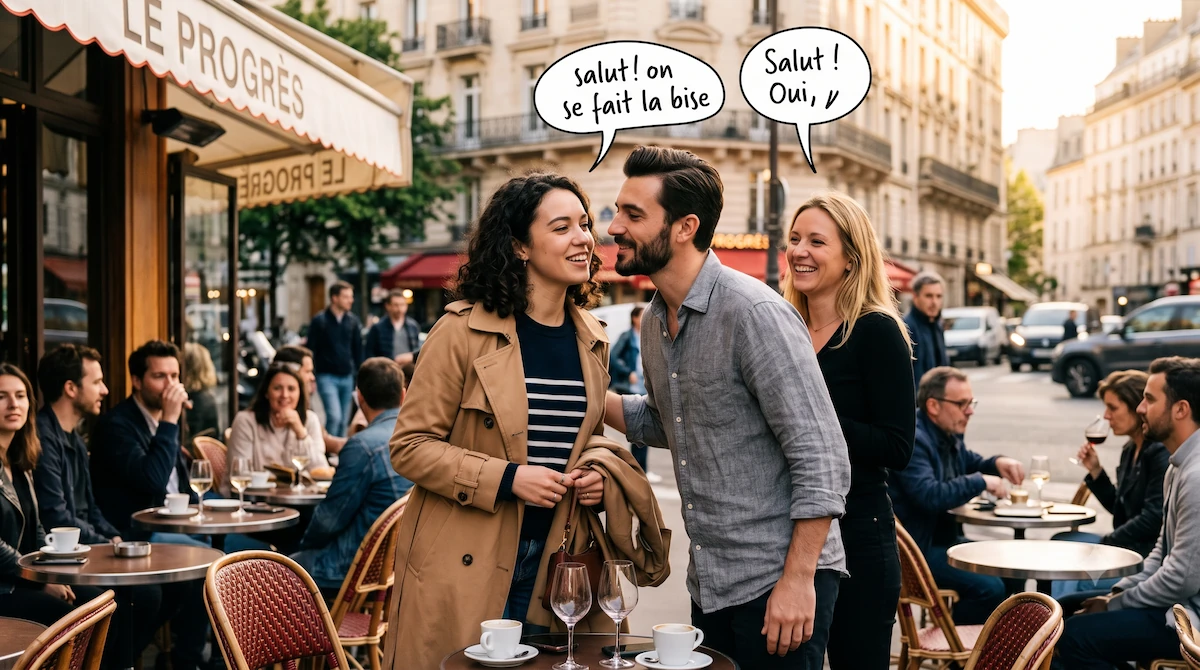
La bise, the French cheek kiss, is one of those things every guide mentions and almost none explain properly. How many? Which cheek first? Do you do it with everyone? Let's actually answer these.
What La Bise Actually Is
A light touch of cheeks, sometimes with a small kissing sound, sometimes an actual light peck, exchanged as a greeting between people who know each other, friends, family, and often colleagues, regardless of gender.
How Many Kisses? It Depends Where You Are
This is the part that trips up even French people moving to a different region. Two kisses is the most common default across much of France, but some regions do three, or even four. There is genuinely no single national rule, and asking "combien de bises chez vous ?" (how many kisses where you're from?) is a completely normal, common question, even among French people meeting from different regions.
Who Does It, and Who Doesn't
Yes, typically: friends, family, close colleagues, especially in casual or social settings.
Often, but context-dependent: new acquaintances introduced through friends, sometimes on a first meeting in a social setting.
Usually not: a first professional meeting, a job interview, or any clearly formal business context, where a handshake is the safer default.
Between men specifically, la bise is common in some regions and social circles, but far from universal, a handshake remains very normal and expected in many contexts, professional or not.
What To Do When You're Not Sure
Here's the honest, practical advice: hesitate half a second and let the other person lead. Lean in slightly, if they extend a hand instead, shift smoothly to a handshake. Every French person has had this exact awkward half-second, it's not a sign you're doing something wrong as a learner, it's just genuinely ambiguous sometimes, even for natives.
Quick Practice: Test Yourself
True or false?
The number of kisses is exactly the same in every region of France.
A job interview is a normal place to do la bise.
Asking how many kisses is normal in a region is a completely acceptable question.
(Reponses : 1. Faux. 2. Faux. 3. Vrai.)
FAQ
How many times do you kiss cheeks in France?
It varies by region, commonly two, sometimes three or four. There is no single national rule.
Do you do la bise with everyone?
No. It fits friends, family, and often colleagues in casual settings, but not first professional meetings, where a handshake is standard.
What if I'm not sure whether to do la bise or shake hands?
Hesitate briefly and follow the other person's lead. This happens to native French speakers too, it's not a beginner mistake.
Is la bise only between women, or between men too?
It varies by region and social circle. It happens between men in some contexts, but a handshake remains completely normal and common too.
Reading the rule is one thing. Actually catching that half-second hesitation in real time, with a real person in front of you, is exactly the kind of instinct you build through real conversation practice, not a page.
That's exactly what SylvAcademy's small group conversation classes are built for.
Ready to navigate real French social situations with confidence? Join a Standard Group session and start practicing this week.
Exercices
Complète chaque phrase en choisissant la bonne réponse.
- 1.Le nombre de bises en France est :
- 2.Vrai ou faux : demander "combien de bises chez vous ?" est une question étrange et impolie.
- 3.Dans un premier entretien d'embauche, il est plus sûr de faire :
- 4.Si tu hésites entre la bise et la poignée de main, la meilleure stratégie est :
- 5.Entre hommes, la bise est :
- 6.Vrai ou faux : même les Français natifs hésitent parfois sur le nombre de bises.
- 7.La bise convient généralement pour :
- 8.Ce moment d'hésitation avant de faire la bise ou une poignée de main est :
- 9.Le nombre de bises le plus courant, à défaut d'indication régionale précise, est généralement :
- 10.Vrai ou faux : la bise remplace toujours complètement la poignée de main dans tous les contextes professionnels.
Prêt à progresser en français ?
Rejoins SylvAcademy et bénéficie d'un accompagnement personnalisé, du niveau débutant à avancé.
Découvrir les cours →Commentaires
Chargement…