Bon Appétit: What It Really Means (And When You Shouldn't Say It)
Bon appétit seems simple, but there's real etiquette behind it: who says it, when to skip it, and the casual shortcut French friends actually use.
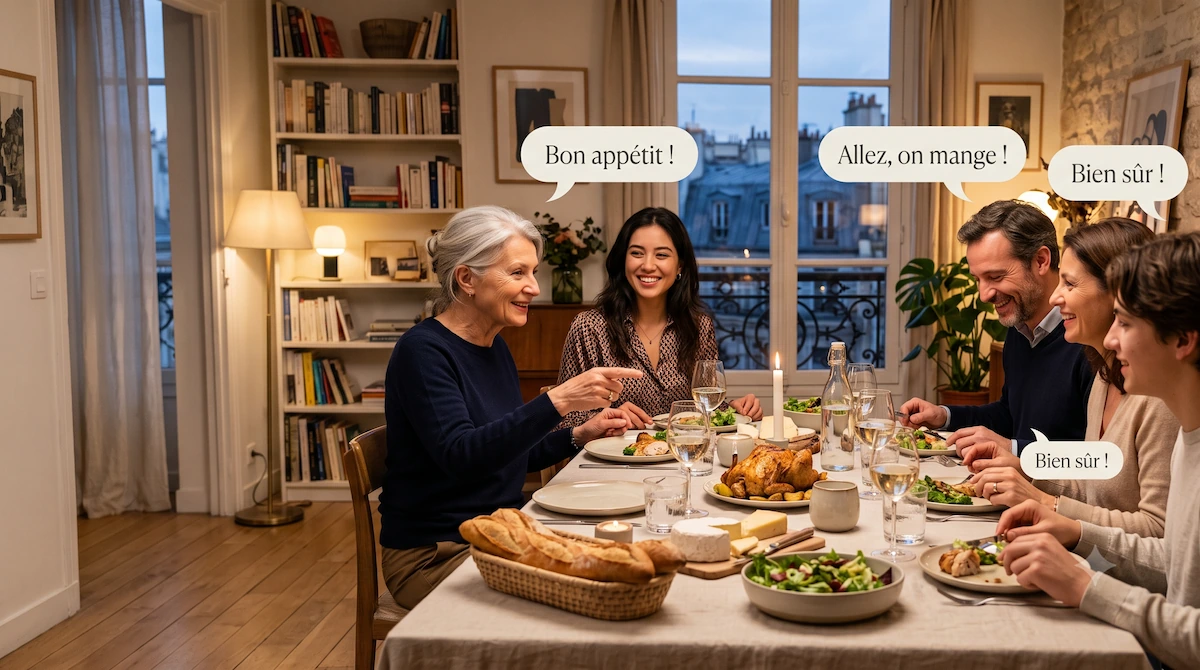
Bon appétit is probably the most universally known French phrase at the table. Simple, warm, easy. But there's a real etiquette hiding behind it that most guides skip entirely.
What Bon Appétit Actually Means
Literally, "good appetite." Said just before a meal starts, it wishes the other person an enjoyable meal, roughly like "enjoy your food," but slightly more formal and universally used, not just for special occasions.
Who Says It, and When
The person who isn't eating yet, or who finishes serving others first, typically says it to those who are about to eat. A host serving a table often says bon appétit to guests before sitting down themselves. At a shared table, it often gets said once everyone has their plate, sometimes exchanged mutually around the table.
A Surprising Rule: When NOT to Say It
Here's the part almost no guide mentions. In genuinely formal settings, an elegant restaurant, a very formal dinner, some French people consider it slightly informal or even unnecessary for staff to say bon appétit to diners, since it can feel presumptuous coming from someone serving rather than sharing the meal. It is common in casual restaurants and homes, but some higher-end establishments deliberately skip it, precisely because they consider it too casual.
Another situation to know: saying it to someone before you eat while they're still waiting for their food to arrive can feel a little awkward, since you're essentially announcing you're about to enjoy something they don't have yet. Many French speakers wait until everyone is served.
The Version Almost Nobody Teaches: Bon App'
Among friends and family, bon appétit often gets shortened casually to bon app', pronounced like "bon ap," dropping the last syllable entirely. It's the equivalent of clipping "enjoy your meal" down to something quicker and more casual.
Quick Practice: Test Yourself
True or false?
Bon appétit is always said by whoever is about to eat, to themselves.
Some elegant restaurants deliberately avoid having staff say bon appétit.
Bon app' is a casual, shortened version used with friends.
(Reponses : 1. Faux, on le dit generalement a quelqu'un d'autre, pas a soi-meme. 2. Vrai. 3. Vrai.)
FAQ
What does bon appétit literally mean?
"Good appetite," used to wish someone an enjoyable meal, typically said just before eating starts.
Is it rude to say bon appétit to a waiter?
Not rude exactly, but it can feel oddly reversed, waiters wish it to diners, not usually the other way around in a natural exchange.
Do fancy restaurants skip bon appétit?
Some do, on purpose, considering it slightly too casual for a very formal dining experience.
What is bon app'?
A casual, shortened version of bon appétit used among friends and family, dropping the final syllable.
Knowing exactly when a phrase fits, and when skipping it is actually more correct, is precisely the kind of real-world nuance you only pick up through actual conversation with a native speaker, not a phrasebook.
That's exactly what SylvAcademy's small group conversation classes are built for.
Ready to learn the etiquette behind the phrases, not just the words? Join a Standard Group session and start practicing this week.
Exercices
Complète chaque phrase en choisissant la bonne réponse.
- 1.Bon appétit signifie littéralement :
- 2.Vrai ou faux : on se dit généralement "bon appétit" à soi-même avant de manger seul.
- 3.Dans certains restaurants très formels, le personnel :
- 4."Bon app'" est une version :
- 5.Si une personne à table n'a pas encore été servie, dire bon appétit à celui qui mange déjà peut sembler :
- 6.Qui dit généralement bon appétit en premier à une table partagée ?
- 7."Bon app'" se prononce en laissant tomber :
- 8.Vrai ou faux : toutes les cultures francophones considèrent bon appétit comme obligatoire en toute occasion.
- 9.Le ton habituel de bon appétit est :
- 10.Pourquoi un serveur qui dit bon appétit peut parfois sembler "inverser" la logique de la formule ?
Prêt à progresser en français ?
Rejoins SylvAcademy et bénéficie d'un accompagnement personnalisé, du niveau débutant à avancé.
Découvrir les cours →Commentaires
Chargement…