Hello in French: More Than Just Bonjour
Bonjour covers a lot, but not everything. Here's what to say on the phone, when meeting someone new, and among friends, without sounding like a textbook.
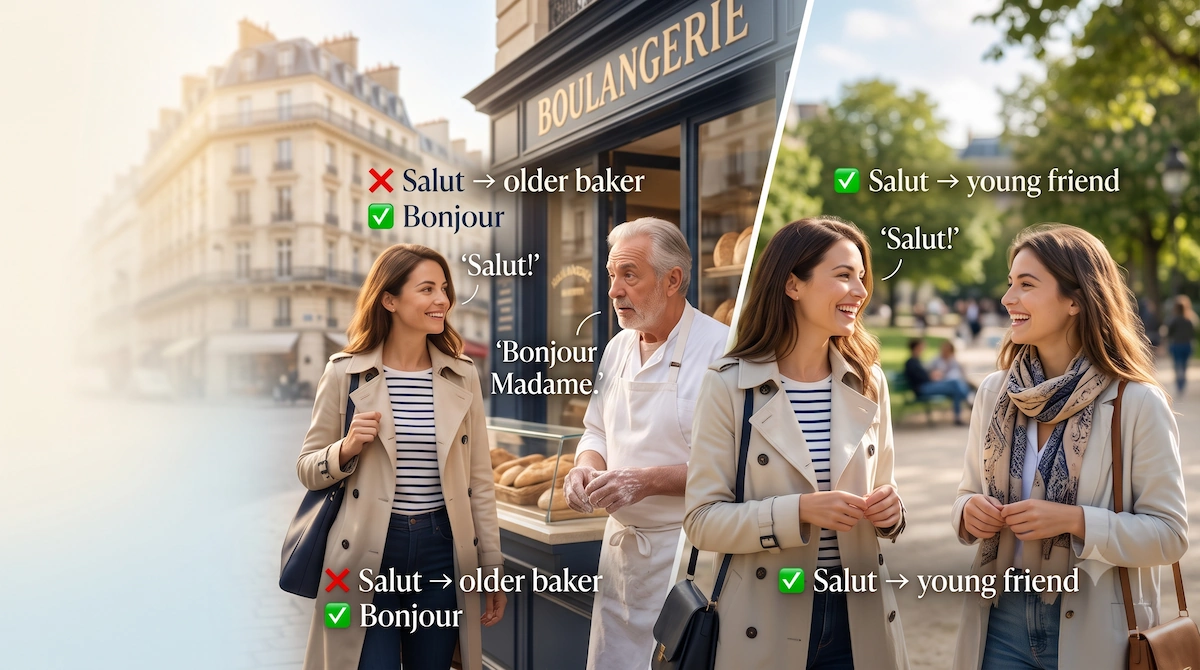
Bonjour will get you through almost any door in France. But rely on it for absolutely everything, and you'll sound a little like you're reading off a flashcard.
Real conversation needs more than one gear. Let's add a few.
Bonjour: Your Safe Default
Quick reminder since it's the foundation for everything else here: bonjour works nearly everywhere, formal or casual, and it's always the safe choice with strangers, older people, or anyone in a professional setting. When in doubt, bonjour never fails you.
Casual Hello: Salut and Coucou
Among friends, French relaxes:
Salut — an easy, all-purpose "hi," fine for friends, classmates, casual coworkers. Also doubles as "bye."
Coucou — warmer, more affectionate, reserved for people you're genuinely close to. Think "hey you" rather than a formal greeting.
Neither belongs in a job interview or with your partner's grandmother. Save them for people who already know you.
Hello on the Phone: Allô
Here's one that trips people up: bonjour is not what French speakers say when picking up the phone. That's allô, a word reserved specifically for answering calls.
Allô ? Qui est à l'appareil ? — Hello? Who's calling?
Answer a phone call with bonjour instead of allô, and it'll sound slightly off, like answering "good day" instead of "hello" in English.
"Nice to Meet You": Enchanté
Meeting someone for the first time calls for its own word: enchanté (or enchantée, if you're a woman speaking). It's short for "je suis enchanté de faire votre connaissance," literally "I'm delighted to make your acquaintance," and functions like "pleased to meet you."
Enchanté ! — Nice to meet you!
Some purists consider it a touch old-fashioned for very casual settings, but it remains completely normal and polite in most everyday introductions.
The Physical Greeting: Handshake or Bise?
Not exactly vocabulary, but this trips up more learners than any word on this list: French greetings often come with a physical component. La bise, a light cheek kiss (or two, or three, or four, depending on the region), is common between friends, family, and often colleagues, regardless of gender.
In more professional or first-time settings, a handshake (serrer la main) is the safer default. When genuinely unsure which one's coming, hesitate half a second and let the other person lead, everyone, including native French speakers, occasionally fumbles this one.
Quick Practice: Test Yourself
Which greeting fits?
You're answering your phone.
You're meeting your girlfriend's parents for the first time.
Your close friend texts you first thing in the morning.
You're greeting a colleague you've worked with for years.
(Answers: 1. Allô, 2. Enchanté(e), 3. Coucou or salut, 4. Salut, or bonjour if the relationship is more formal)
FAQ
Do French people say bonjour on the phone?
No, that's allô, a word used specifically for answering calls. Bonjour is for in-person and most other written or spoken greetings.
What does enchanté mean exactly?
It's short for "I'm delighted to make your acquaintance," used the moment you're introduced to someone new. Women say enchantée, with an extra "e" sound.
Is salut rude in French?
Not rude, just casual, the equivalent of "hi" rather than "hello." Fine with friends and peers, not appropriate in formal or professional settings with people you don't know well.
Do you always kiss on the cheek to greet someone in France?
Very common between friends, family, and often colleagues, but not universal, and the exact number of kisses varies by region. In professional or first-time settings, a handshake is the safer choice.
Reading these words is one thing. Reaching for the right one without hesitating, in front of a real person, cheek already halfway to yours, that's a different skill entirely.
That's exactly what SylvAcademy's small group conversation classes are built for.
This is just one greeting among several worth knowing. See the complete beginner's guide to speaking French for the full roadmap.
Ready to greet people naturally, in every situation? Join a Standard Group session and start practicing this week.
Exercices
Complète chaque phrase en choisissant la bonne réponse.
- 1.Tu décroches ton téléphone. Tu dis :
- 2.Tu rencontres quelqu'un pour la première fois. Tu dis :
- 3.Tu retrouves un ami proche. Tu dis :
- 4.La bise en France se fait généralement :
- 5.Dans un cadre professionnel avec un inconnu, il est plus sûr de faire :
- 6.Tu entres dans un magasin et salues poliment le vendeur âgé. Tu dis :
- 7.Tu salues un enfant de 4 ans dans la rue. Tu dis :
- 8.Tu commences un appel vidéo professionnel avec un client. Tu dis :
- 9.Tu retrouves un groupe de 3 amis proches au bar. Tu dis :
- 10.On te présente quelqu'un pour la première fois lors d'une soirée, tu dis :
Prêt à progresser en français ?
Rejoins SylvAcademy et bénéficie d'un accompagnement personnalisé, du niveau débutant à avancé.
Découvrir les cours →Commentaires
Chargement…