Faire Conjugation: The Verb for Everything You Do
Faire runs the weather, your sports, your chores, and half the expressions you'll use daily. Learn this one verb properly, and French gets a lot easier.
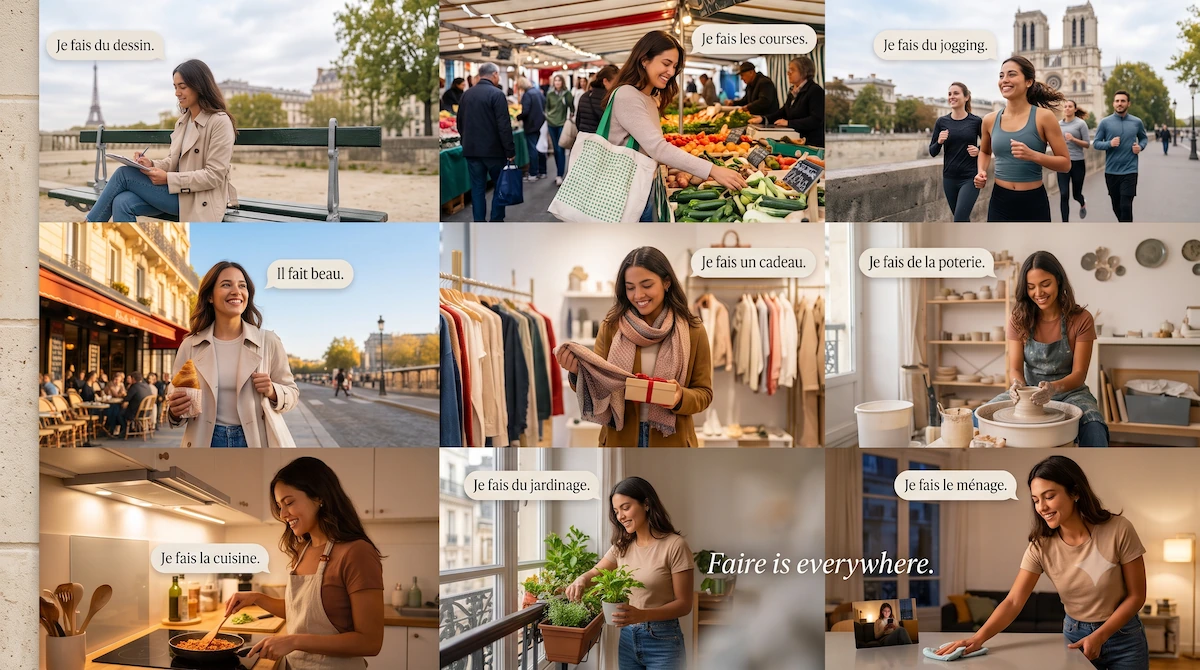
Faire technically means "to do" or "to make." In practice, it means a lot more than that. Talk about the weather, your workout, your homework, or half your daily routine, and faire shows up constantly.
Learn this verb properly, and a surprising number of French sentences suddenly get easier.
Faire: To Do, To Make, and So Much More
Faire covers the obvious:
Je fais mes devoirs. — I'm doing my homework.
Elle fait un gâteau. — She's making a cake.
But it also covers weather, sports, and a long list of set expressions where English would never think to use "do" or "make" at all. More on that below.
Faire in the Present Tense
Je fais — I do / make
Tu fais — You do / make
Il / Elle / On fait — He / She / We (casual) does/makes
Nous faisons — We do / make
Vous faites — You do / make
Ils / Elles font — They do / make
Two pronunciation traps worth catching early: nous faisons is pronounced with a "z" sound and only one "s" (not "fai-ssons"), and the final "s" in vous faites stays silent. Small details, but they're exactly what separates a hesitant learner from someone who sounds comfortable.
The Weather Verb: Il Fait...
French routes almost all weather talk through faire, using the impersonal il:
Il fait beau. — The weather's nice.
Il fait chaud. — It's hot.
Il fait froid. — It's cold.
Il fait du soleil. — It's sunny.
Notice English switches to "it's," while French keeps faire doing the work. Direct translation trips people up here more than almost anywhere else in the language.
Sports and Activities: Faire vs Jouer
Here's a genuine trap for English speakers. English uses "play" broadly (play tennis, play soccer, play the piano). French splits this into two different verbs depending on the activity:
Jouer — for games and instruments: jouer au foot, jouer au tennis, jouer du piano
Faire — for individual sports, exercise, and physical activities: faire du sport, faire de la natation (swimming), faire de la randonnée (hiking), faire du yoga
Rough rule of thumb: if it's a game with a ball, teams, or an instrument, reach for jouer. If it's exercise or an individual activity, faire is usually the safer bet.
Faire in the Passé Composé and Futur Proche
Passé composé (with avoir): j'ai fait, tu as fait, il a fait, nous avons fait, vous avez fait, ils ont fait. Qu'est-ce que tu as fait ce week-end ? — What did you do this weekend?
Futur proche: je vais faire, tu vas faire, il va faire, nous allons faire, vous allez faire, ils vont faire. Je vais faire les courses. — I'm going to do the groceries.
Quick Practice: Test Yourself
Fill in the blank with faire or jouer, correctly conjugated:
Il ______ très chaud aujourd'hui. (weather)
Nous ______ du yoga tous les matins.
Ils ______ au tennis le samedi.
Qu'est-ce que tu ______ hier soir ? (passé composé)
(Answers: 1. fait, 2. faisons, 3. jouent, 4. as fait)
Faire rounds out the five essential verbs covered in the complete guide to speaking French, your full roadmap from zero to conversational.
FAQ
Is faire an irregular verb?
Yes, especially in the nous and vous forms (faisons, faites), which don't follow the pattern you'd expect from the rest of the conjugation.
How do you talk about weather in French?
Almost always with faire and the impersonal il: il fait beau, il fait froid, il fait du vent. Weather is one of the most common everyday uses of this verb.
What's the difference between faire and jouer for sports?
Jouer is for games with a ball or team, or for instruments (jouer au foot, jouer du piano). Faire is for individual sports and exercise (faire du sport, faire de la natation).
Why is nous faisons pronounced differently than it's spelled?
It's one of French's quirks, faisons is pronounced with a "z" sound and a single "s" sound, not doubled the way the spelling might suggest.
Knowing the conjugation is one thing. Reaching for faire instead of jouer without hesitating, mid-conversation, about your weekend plans, that comes from real speaking practice, not from a table.
That's exactly what happens inside SylvAcademy's small group conversation classes.
Ready to make faire second nature? Join a Standard Group session and start practicing this week.
Exercices
Complète chaque phrase en choisissant la bonne réponse.
- 1.Il très beau aujourd'hui.
- 2.Nous du yoga tous les matins.
- 3.Ils au tennis le samedi.
- 4.Qu'est-ce que tu hier soir ?
- 5."Nous faisons" se prononce avec quel son ? avec
- 6.Tu la cuisine ce soir ?
- 7.Vous de la randonnée ce week-end ?
- 8.Il très froid en hiver à Paris.
- 9.Ils du vélo tous les dimanches.
- 10."Jouer au piano" utilise quel verbe, faire ou jouer ?
Prêt à progresser en français ?
Rejoins SylvAcademy et bénéficie d'un accompagnement personnalisé, du niveau débutant à avancé.
Découvrir les cours →Commentaires
Chargement…